


General Overview
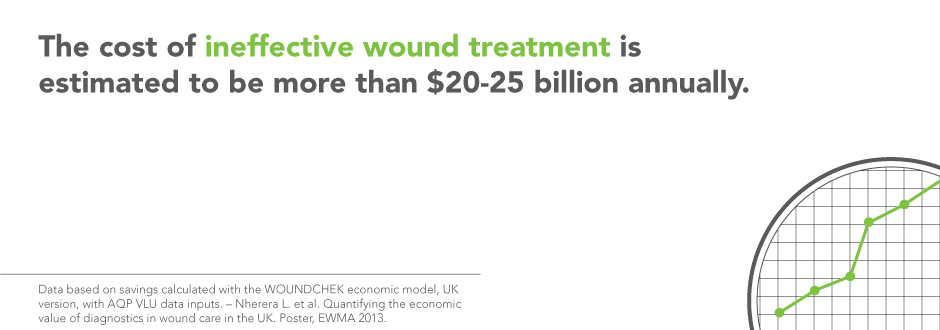
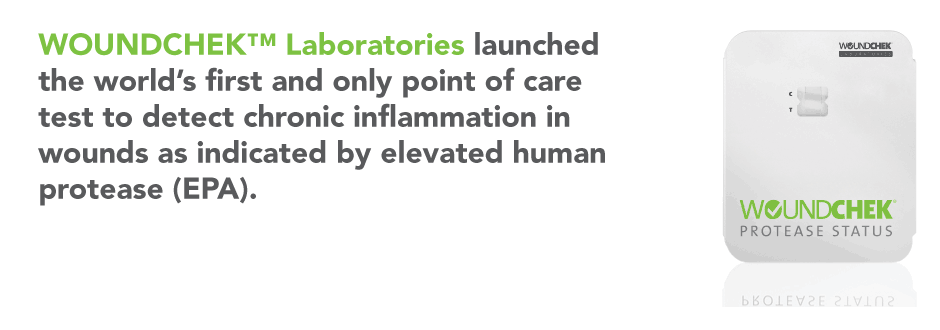
WOUNDCHEK™ Laboratories is focused on the development of novel wound diagnostic products to help improve outcomes in wound care. Currently, the cost of ineffective treatment is estimated to be more than $20-25 billion¹Data based on savings calculated with the WOUNDCHEK economic model, UK version, with AQP VLU data inputs. – Nherera L. et al. Quantifying the economic value of diagnostics in wound care in the UK. Poster, EWMA 2013. annually. Clinical experts agree the use of point of care wound diagnostic devices could reduce the cost of ineffective treatment and delayed healing by being able to target the right therapy, on the right patient, at the right time, and for the right length of time²World Union of Wound Healing Societies (WUWHS). Principles of best practice: Diagnostics and wounds. A consensus document. London: MEP Ltd, 2008.. A resulting financial benefit to health care systems can be achieved through significant reduction of the expenses associated with poor targeting of treatment, delayed healing, and avoidable complications. WOUNDCHEK™ Laboratories launched the world’s first and only point of care test to detect EPA (elevated protease activity) in chronic wounds in 2012, and over the past several years has become a recognized leader in wound diagnostics.
Mission
The company’s vision is to provide clinicians with better, accurate, timely, actionable, and easy to access information, leading to improved outcomes through point of care wound diagnostics. WOUNDCHEK™ Laboratories aims to be the leading and dominant enterprise in wound diagnostics by providing medical professionals with the diagnostic information to:
-
Identify wounds which are not healing
-
Intercept issues and early warnings that cause poor wound healing or initiate wounds
-
Aid in determination of best therapeutic routes
-
Monitor the effectiveness of a course of treatment
Activities
Based in the UK and the USA, WOUNDCHEK™ Laboratories' staff are focused on product development, clinical research, and working with its distribution partners to develop the emerging wound diagnostics market.
Our research is centred on two critical questions, identified by clinical experts as primary pieces of diagnostic information needed to direct treatment pathways in the majority of chronic wounds:
-
Does the wound have chronic inflammation?
-
Is there an active bacterial pathogenesis?
ISO 13485:2016 certified quality management system.
Bacterial Virulence
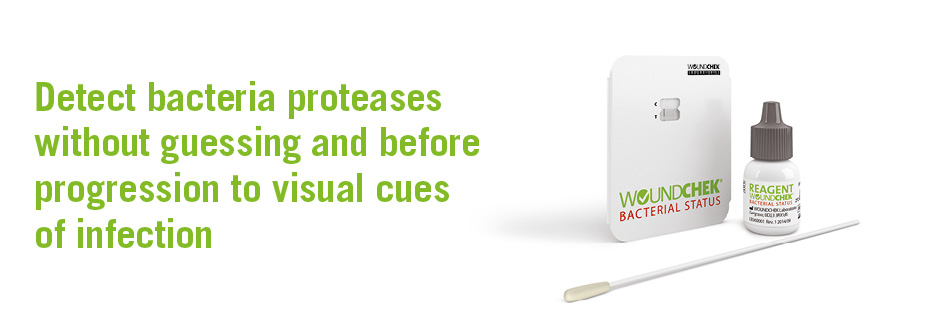
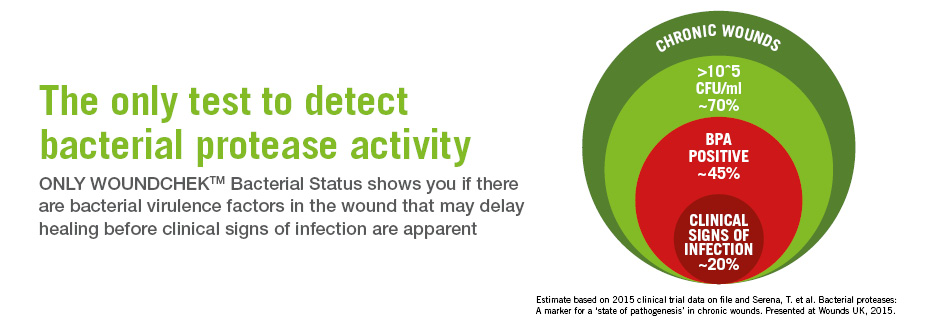
Bacterial proteases have been described as the most important class of virulence factors and play a key role in the establishment of wound infections, ultimately impeding the healing response and keeping the wound in a chronic state1Koziel J, Potempa J. Protease-armed bacteria in the skin. Cell Tissue Res. 2013; 351(2): 325-37.. They are produced by both Gram-negative and Gram-positive bacteria associated with chronic wound colonization2Wysocki AB, Bhalla-Regev SK, Tierno PM, Steven-Riley M, Wiygul R. Proteolytic Activity by Multiple Bacterial Species Isolated from Chronic Venous Leg Ulcers Degrades Matrix Substrates. Biol Res Nurs. 2012; 15(4): 407-415..
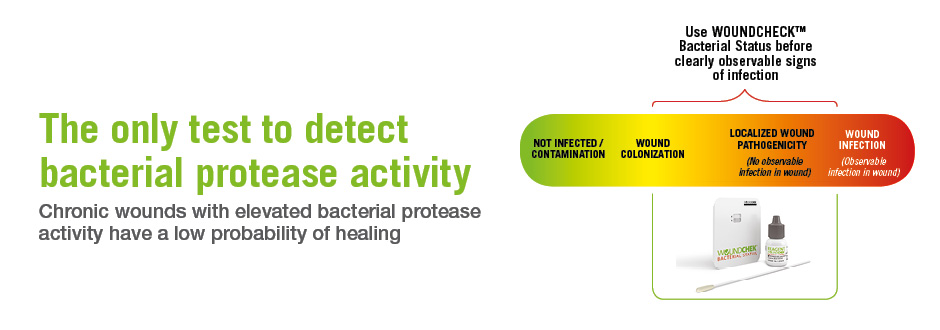
The detection of bacterial protease activity in a chronic wound would be indicative of the presence of bacterial virulence which is a precursor to clinical signs and symptoms of infection3Thomson PD, Smith DJ. What is infection? Am. J. Surg. 1994; 167(No. 1A): 7S-10S.,4Dow G, Browne A, Sibbald RG. Infection in chronic wounds: Controversies in diagnosis and treatment. Ostomy Wound Management 1999; 45 (8): 23-40. .
Bacterial virulence is undesirable since, at this stage, the wound is in a part of the wound infection continuum that typically requires intervention.
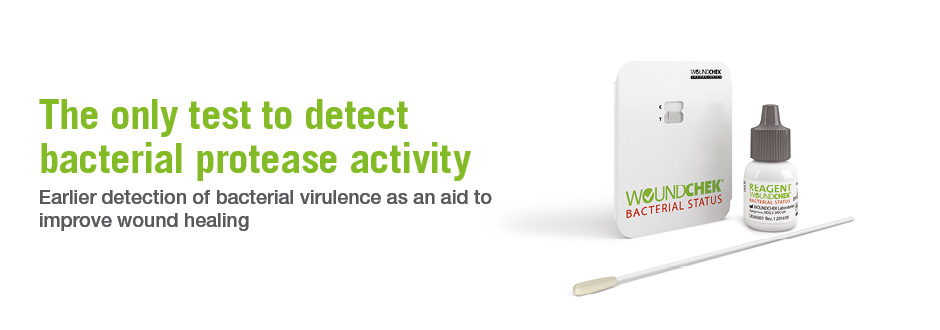
WOUNDCHEK™ Bacterial Status — Now available in countries accepting CE mark or FDA clearance!
|
PRODUCT CODE |
DESCRIPTION |
CONTAINS |
|
360006 |
WOUNDCHEK™ Bacterial Status |
6 tests (all material needed) |
|
360010 |
WOUNDCHEK™ Bacterial Status |
3 positive & 3 |
The Only Test to Detect EPA
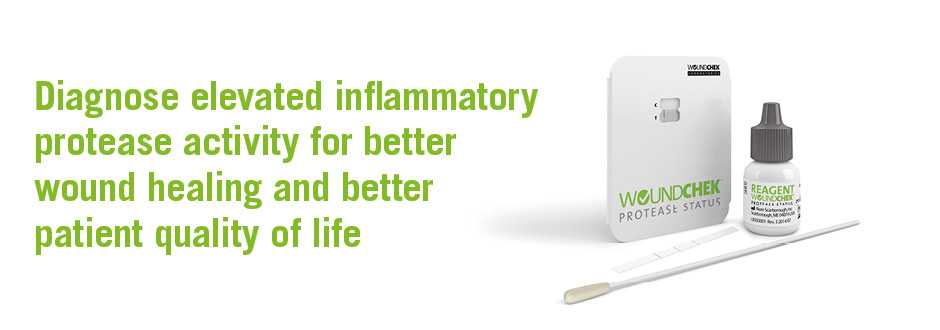
Developed to aid wound assessment and help clinicians target advanced wound care therapies more effectively, WOUNDCHEK™ Protease Status is able to detect EPA (elevated protease activity). As there are no visual cues for EPA, wounds with EPA have so far gone undetected1Snyder R. et al. A survey: The importance of proteases in wound healing and wound assessment. Poster, Wounds UK 2011..
WOUNDCHEK™ Protease Status will help clinicians establish within minutes which wounds may most benefit from a protease modulating therapy, ensuring appropriate and targeted use of these therapies.
WOUNDCHEK™ Protease Status product sizes — Now available in countries accepting CE mark!
|
PRODUCT CODE |
DESCRIPTION |
CONTAINS |
|
350006 |
WOUNDCHEK™ Protease Status |
6 tests (all material needed) |
|
350010 |
WOUNDCHEK™ Protease |
3 elevated result and |
Videos


Disclaimer:
The product information on this page is not intended for, or to be used by health care professionals or users in the United States
Evidence


Posters & Articles
 Serena TE, et al, 2016. Defining a new diagnostic assessment parameter for wound care: Elevated protease activity, an indicator of nonhealing, for targeted protease-modulating treatment
Lazaro J., et al, 2016. Elevated levels of matrix metalloproteinases and chronic wound healing: an updated review of clinical evidence
Izzo I., et al, 2014. High matrix metalloproteinase levels are associated with dermal graph failure in diabetic foot ulcers
Frenthoff, E. et al. 2015. Testing and treating for elevated protease activity (EPA) in wound care clinics improves clinical outcome at no additional cost
Uccioli, L. et al. 2014. The presence of elevated protease activity (EPA) influences the integration of dermal grafts in diabetic foot ulcers
Gibson, M. et al. 2013. Testing chronic wounds for EPA. The benefits of testing all wounds, whether assessed as healing or non-healing
Ivory, 2013. The cost implications of implementing Woundchek Protease Status into clinical practice
Ivory, 2013. Assessing chronic non healing wounds for elevated protease activity
Anichini, R. et al. 2013. Detecting and treating Elevated Protease Activity (EPA) in chronic diabetic wounds
Duteille, F. 2013. Evaluation of the use of point-of-care test for proteases to identify patients with increased risk of skin graft failure
Nherera, L. et al. 2013. Quantifying the economic value of diagnostics in wound care in the UK
International case series: Using Promogran/Promogran Prisma on wounds with elevated protease activity: case studies. London: Wounds International, 2013.
Young, T. 2012. Using a protease test to inform wound care treatment decisions
Haycocks, 2012. Assessing chronic diabetic foot wounds for elevated protease levels
Hodgson, 2012. Clinical skills of tissue viability nurse versus Woundchek to detect elevated protease activity (EPA)
Serena, T. et al. 2012 Preliminary results: Testing for elevated protease activity in clinical practice
Johnstone, 2012. Case Studies: Testing for and treating EPA
Cullen, B. et al 2012. Targeted use of Collagen/ORC improves clinical outcome
Serena, T. et al. 2011. Protease activity levels associated with healing status of chronic wounds
Snyder, R. et al. 2011.The importance of proteases in wound healing and wound assessment
Consensus Documents
Diabetic Foot Ulcers: Prevention, Care and Treatment Spanish Diabetes Foundation, 2014
Die tolle eines proteasen schnelltests in der wunddiagnostik DACH, 2013
Using a diagnostic tool to identify elevated protease activity levels in chronic and stalled wounds USA, 2013
EPA made easy, Wounds International, 2013.
Protease diagnostic in wound care UK, 2012
Role of proteases in wound diagnostics International, 2012
Significato e valutazione delle proeasi nel processo di riparazione tessutale Italy, 2012
The role of a point-of-care protease activity diagnostic test in Canadian clinical practice Canada, 2012
World Union of wound healing societies consensus document International 2012
Symposia
Dr. Läuchli, Dr. Anichini, Dr. Dowsett, and Prof. Duteille, EWMA 2013 EPA, guiding treatment decisions for improved clinical results and cost effective care
Dr. Serena, Dr. Fletcher, and Dr. Läuchli, EWMA 2012 Testing for EPA, the arrival of wound diagnostics
Dr. Thoms, Training Event 2012 Proteases: Background, Assessment, and Treatment of EPA in chronic wounds (in German)
Disclaimer:
The product information on this page is not intended for, or to be used by health care professionals or users in the United States
Evidence
Posters & Articles
Serena, T. et al. 2017. A Rapid Point of Care Test for Bacterial Protease in Chronic Wounds is Predictive of Amputation Risk
Serena, T. et al. 2015. Bacterial proteases: A marker for a 'state of pathogenesis' in chronic wounds
Serena, T. et al. 2015. Bacterial protease activity in chronic wound fluid, a potential indicator of pathogenicity even in the absence of overt signs of infection.
Benson, R. et al. 2013. Bacterial protease activity, an indicator of bacterial pathogenicity in chronic wounds even in the absence of overt clinical signs.
Consensus Documents
Wound Infection in Clinical Practice, International Wound Infection Institute, 2016
BPA Made Easy Wounds International, Serena T., et al, 2016
The Use of a point-of-care test for bacterial protease activity in chronic wounds Wounds International 2015, Vol 6 Issue 4
Symposia
content coming soon.
Disclaimer:
The product information on this page is not intended for, or to be used by health care professionals or users in the United States
Videos

Areas of Interest
The strategy of WOUNDCHEK™ Laboratories is to be the leading and dominant enterprise in wound care diagnostics by providing medical professionals with the diagnostic information to:
-
Identify wounds which are not healing
-
Intercept issues and early warnings that cause poor wound healing or initiate wounds
-
Aid in determination of best therapeutic routes
-
Monitor the effectiveness of a course of treatment
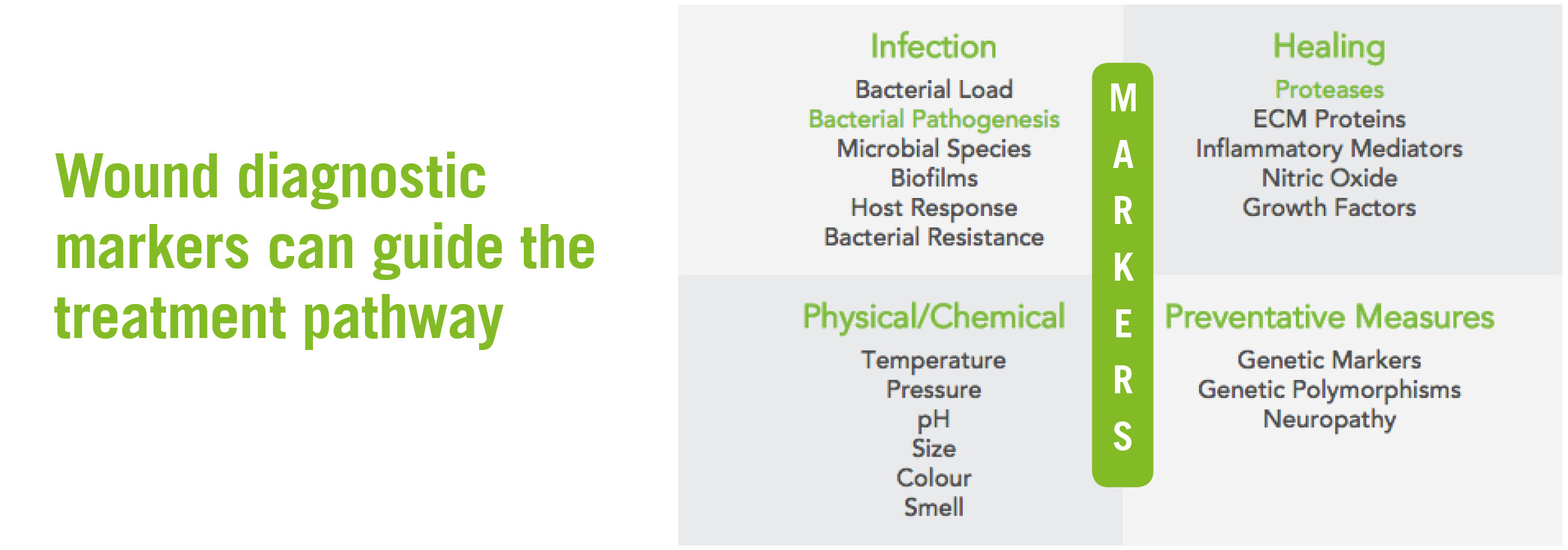
Clinical experts identified numerous markers that could form the basis of new diagnostic tools for use in wound care1World Union of Wound Healing Societies (WUWHS). Principles of best practice: Diagnosis and wounds. A consensus document. London: MEP Ltd, 2008.(see slide above).

Jack Wilkens
Chief Executive Officer

Simon Bayliff
Vice President, R&D

Malcolm Williams
Chief Financial Officer

Patrick Brosnan
Scientist

Gill Witherington
Administrator

Richard Collette
Commercial
-
Jack Wilkens
Chief Executive Officer

Leon Okurowski

Bill Umphrey
|
Jack Wilkens Former Systagenix Vice President of Diagnostics Development, CEO of RevDia, which specializes in infectious disease point of care diagnostic testing. Prior to RevDia, he was Chief Operating Officer for Inverness Medical Innovations (now Alere - ALR-NYSE), a world leader in point of care rapid diagnostics. He has also held senior management positions with Unipath, IMI, Sterling Diagnostics / AGFA and Polaroid Corporation. Mr. Wilkens has a BS in Chemical Engineering and an MBA. |
|
Simon Bayliff Simon is a Biochemistry & Physiology graduate with nearly 30 years' experience developing products in the Medical Device and In-Vitro Diagnostic fields. He has worked in 'start-up' environments and for companies including Abbott Laboratories and Johnson & Johnson. |
|
Patrick Brosnan, BSc Patrick has worked in wound care for the past five years, with Systagenix. He worked for four years as an R&D scientist and more recently has moved into the clinical side of the company, helping run, monitor and analyse trials in USA. Patrick graduated from The University of Manchester in 2008 with a BSc (hons) in Biology. |
|
Gill Witherington Gill has worked in admin for 13 years in Gargrave, firstly for Johnson & Johnson, which then became Systagenix Wound Management for the Research & Development Department and has to be able to deal with a vast range of tasks. |
|
Malcolm Williams Malcolm is a fellow of the chartered institute of management accountants (UK) as well as having an honours degree in accountancy and finance. He spent 22 years with Johnson and Johnson working mainly in medical devices and diagnostics. Latterly he was the international finance director for Ortho Clinical Diagnostics covering Europe, Africa and Asia. He now works for several start up businesses. |
|
Bob Dicheck Bob Dicheck is an experienced regulatory and quality management professional, who has been involved in U.S. and international regulated industries for more than 30 years. Previously he was Vice President of Quality & Regulatory Affairs for Osmetech Molecular Diagnostics and Vice President Worldwide QA/RA at Unipath, Inverness Medical Innovations. Prior to that Bob held a variety of corporate and global franchise executive level QA/RA positions over 14 years within the Johnson & Johnson family of companies. |
|
Richard Collette Richard Collette is an experienced Commercial Business Leader in international business development for medical products such as diagnostic imaging equipment, tele-care for chronic wound management, IVDs, and implantable devices covering the past 20 years. Most recently, he was President of the USA and Canada marketing, sales, distribution, and service operation for one of the leading suppliers of implants that restore hearing to those challenged with profound hearing loss. |
|
Jack Wilkens Former Systagenix Vice President of Diagnostics Development, CEO of RevDia, which specializes in infectious disease point of care diagnostic testing. Prior to RevDia, he was Chief Operating Officer for Inverness Medical Innovations (now Alere - ALR-NYSE), a world leader in point of care rapid diagnostics. He has also held senior management positions with Unipath, IMI, Sterling Diagnostics / AGFA and Polaroid Corporation. Mr. Wilkens has a BS in Chemical Engineering and an MBA. |
|
Leon Okurowski Mr. Okurowski is the Vice President of Pear Tree Advisors and the co-founder and Vice-President of the Pear Tree Funds. He is also Vice President and Treasurer for various U.S. Boston entities. Mr. Okurowski has over forty years experience in the finance and investment management business. Mr. Okurowski obtained his MBA from the Whittemore School of Business at the Univerity of New Hampshire, his MS in taxation from Bentley College, and a BS from the United States Naval Academy. He has served on the boards of several high-tech companies. He was a co-founder and served on theboard of Atlantic Bank and Trust Prior to joining U.S. Boston, |
|
Bill Umphrey Mr. Umphrey is the Chairman and co-founder of the Pear Tree Funds, the President of Pear Tree Advisors, Inc., and the Chairman of U.S. Boston Capital Corporation. Mr. Umphrey founded the U.S. Boston's predecessor in 1969 and has over forty years of experience in the finance and investment management business. Mr. Umphrey obtained his JD from Harvard Law School, an LLM in taxation from Boston University of Law, a Masters in Personnel Administration fron George Washington Univeristy, and a BS with distiction from the United States Naval Academy in Annapolis, Maryland. Prior to founding U.S. Boston, |
 Events
 News
News
Date: Oct 1, 2019
Date: Apr 4, 2017

Date: Dec 2, 2019
FDA clears WOUNDCHEK™ Bacterial Status for use by wound care professionals
Woundchek Laboratories are excited to announce that the FDA has cleared Bacterial Status for use in the USA by health care professionals whose clinical practice primarily or routinely involves the assessment and treatment of chronic wounds. Bacterial Status results are intended for use in conjunction with the assessment of other known risk factors for wound healing that significantly contribute to the assessment of risk for non-healing chronic wounds such as wound age, wound size, and vascular status.
Bacterial Status is intended for use in adult patients as an aid in assessing the risk for non-healing of chronic venous, diabetic foot, and pressure ulcers associated with wounds where patients are asymptomatic for clinical signs of infection. The test is intended for use with chronic wounds that are between 21 days and < 6 months of age and chronic wounds that are > 6 months of age that are < 1cm2 in size.
 Contact Us
WOUNDCHEK™ Laboratories
Airebank Mill
Gargrave; BD23 3RX
North Yorkshire
United Kingdom
T: +44 (0) 1756 639111
 E:
E: Technical Helpline:
+800 1558 8551
 Map & Directions
From the North
From the South West
From the South East
Our Distributors
For a complete list of our distributors, please submit your request using the form to the right.
If you are interested in becoming a distributor, please submit your request using the form to the right.
